
At Summerfest 2026, Newmag will present Georgi Gospodinov’s “Time Shelter” (trailer)
06/22/2026

Newmag presents the new novel by one of the most remarkable voices of contemporary European literature, Georgi Gospodinov, author of the internationally acclaimed “The Physics of Sorrow”. “Time Shelter” is a sharp, emotional and tragicomic story about memory, nostalgia and the human desire to return to the past when the present becomes uncertain.
What happens when the future loses its meaning, and the past becomes the only place where people feel safe? Georgi Gospodinov’s novel “Time Shelter” explores the fragile boundary between memory, identity and the passage of time.
The story begins with the creation of the “Clinic of the Past” in Zurich. At first, it appears to be a medical experiment: carefully recreated environments from different decades are used to help Alzheimer’s patients recover their memories. Old furniture, familiar objects, sounds and details of everyday life recreate a lost world.
But soon it becomes clear that the experiment has gone beyond medicine. The past begins to attract not only patients, but also healthy people who are searching for stability and certainty in a world that is changing too quickly.
Nostalgia transforms from a personal feeling into a system. It is organized, recreated and even turned into a product, offering people the illusion of returning to a time that seems calmer and more predictable than the present.
At the center of the novel is Gaustin, a mysterious character who seems to exist outside ordinary time, and the unnamed narrator, who collects fragments of the past: objects, smells, sounds, memories and forgotten emotions. These fragments become the foundation for rebuilding lost worlds, but the novel also reveals the danger of becoming trapped inside them.
In “Time Shelter”, Gospodinov asks a profound question: what happens when people stop accepting the present and begin searching for salvation in the past? Time is no longer simply a sequence of moments, but a space where one can choose a preferred era and hide from uncertainty. Yet what appears to be a refuge can also become a limitation.
“Time Shelter” is a philosophical and deeply human novel about memory, nostalgia and the impossible attempt to control time. It is a story about the attraction of the past and the challenges of living in the present.
The Armenian translation of the novel was done by Gohar Abovyan, who also translated Gospodinov’s “The Physics of Sorrow” into Armenian.
The main partner of the book is Eurostan Uyut.
The presentation will take place at Newmag Summerfest 2026, at the Library Cafe in Yeraz Park, at 6:30 PM. The discussion will be hosted by members of Newmag Signature Club.
Share


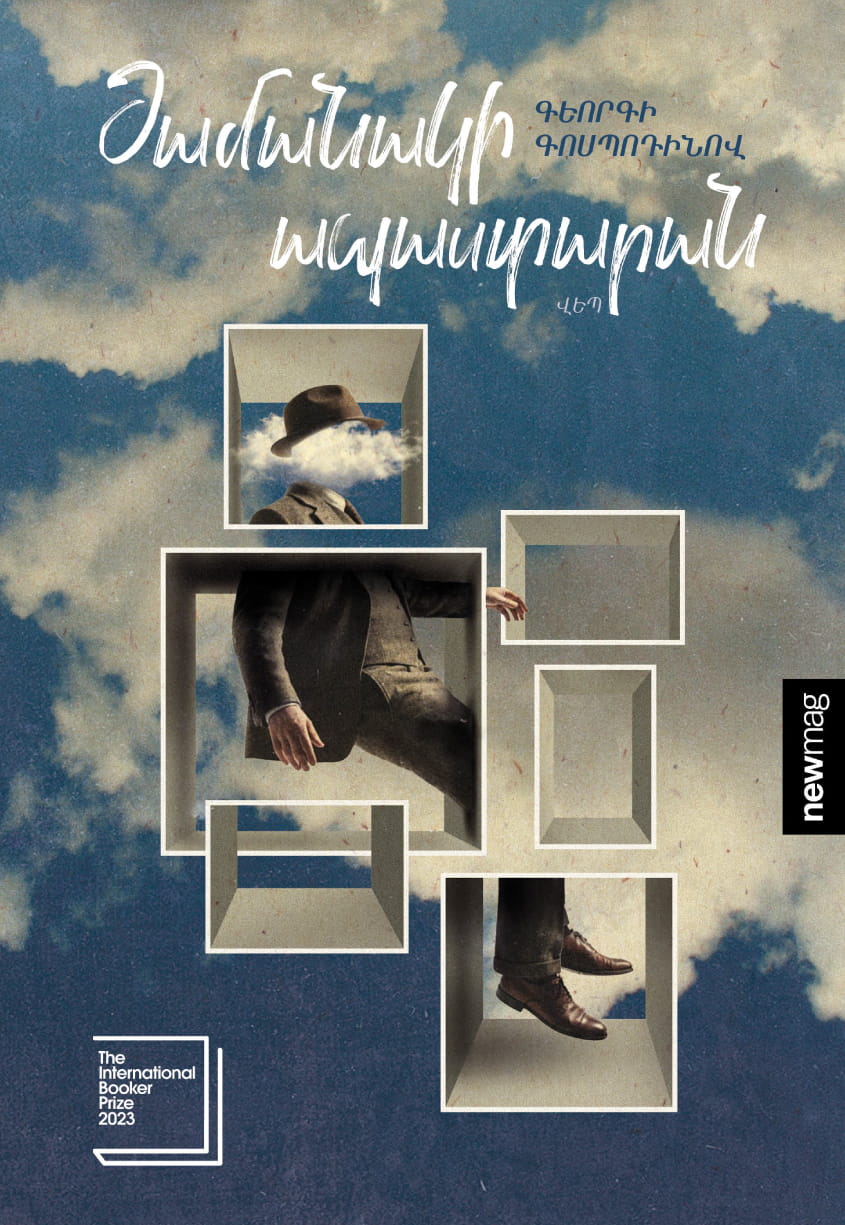
Georgi Gospodinov
6800 ֏
Description
“Time Shelter” invites us into a world desperately seeking to return to the past before it is finally forgotten. The story begins: “At one point they tried to calculate when time began, and when the planet Earth was created. The Irish bishop Usher, in the mid-17th century, calculated not only the exact year, but also the date: October 22, 4004 B.C. It was a Saturday (naturally). According to some, Usher also noted the exact time, around 6 p.m..”
However, time for the narrator, in his own perception, begins at the moment when he meets Gaustin, the “time wanderer.” Gaustin has moved away from modern reality: he reads old newspapers, wears old clothes, and wanders the forgotten avenues of the 20th century. Gaustin opens the first “Clinic of the Past” in Zurich. People with Alzheimer's are offered a unique treatment here: each floor of the building meticulously recreates one of the past decades.
Gaustin's assistant is the book's mysterious, anonymous narrator, whose job is to collect fragments of the past - from 1960s furniture and 1940s shirt buttons to nostalgic scents and barely noticeable rays of afternoon light. The more convincing the reproduction of the era becomes, the more people come to the clinic. Even healthy people come to escape the chaos of everyday life. A sharp, moving and at the same time tragicomic story about the temporary refuge that we seek in the past when the present does not obey us.
Read also