
Newmag Presented Georgi Gospodinov's Novel "Time Shelter" on Armenia TV's “Good Morning” Program (Video)
07/10/2026

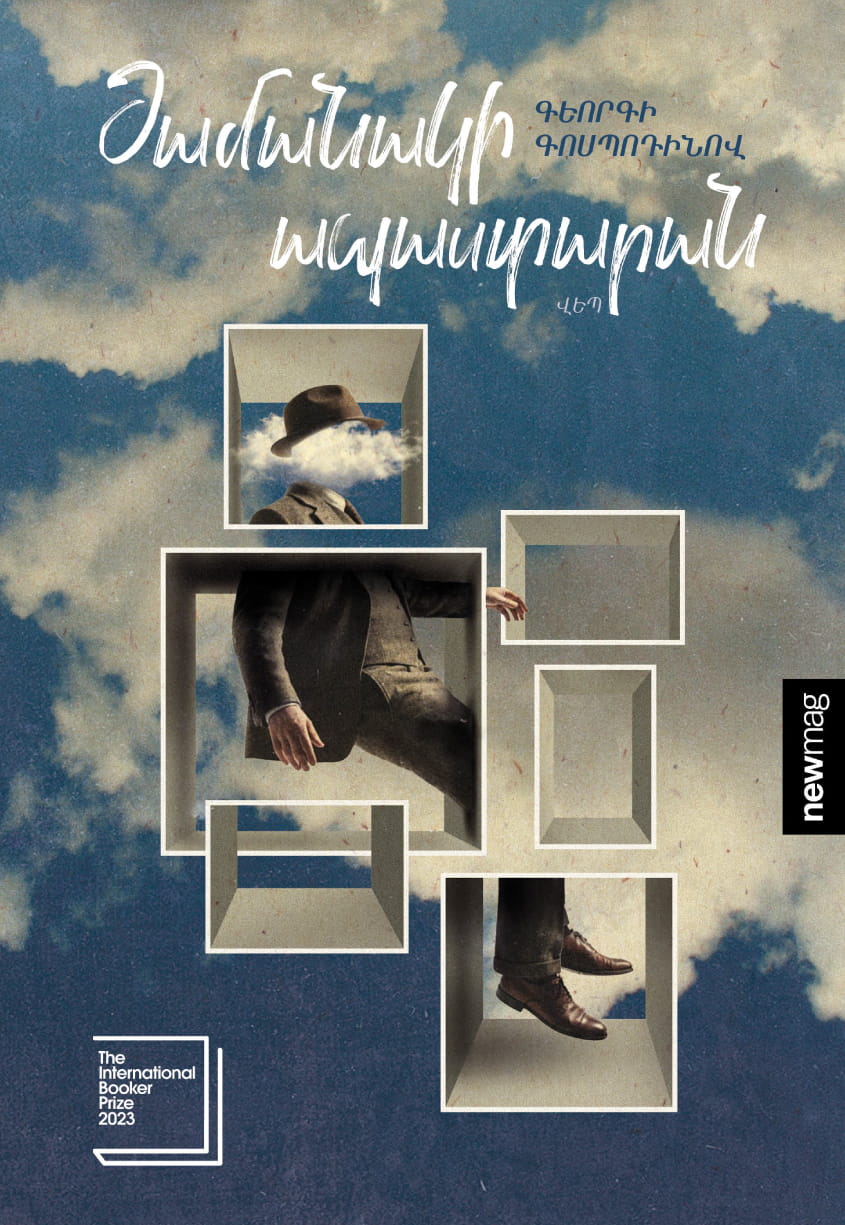
Newmag Publishing House presented the Armenian edition of Bulgarian writer Georgi Gospodinov's novel "Time Shelter" on Armenia TV's Good Morning program. The book was introduced by its Armenian translator, Gohar Abovyan, together with Tatevik Gyulmisaryan, a member of the Newmag Signature Club and a book blogger.
According to Gohar Abovyan, translating Gospodinov requires more than linguistic accuracy. The real challenge lies in understanding the author's style, voice, and rhythm. Gospodinov himself suggests the rhythm for the novel by referencing Handel's Sarabande, whose atmosphere accompanied her throughout the translation process.
"The author says that his book is about memory, the past, and our relationship with it. He explores whether returning to the past is truly possible, whether it is desirable, and what role memory plays in shaping our identity. The novel combines philosophical reflection with elements of essay writing and political commentary."
Abovyan noted that Gospodinov never imposes conclusions or offers simple answers. Instead, he invites readers to reflect and draw their own interpretations.
"He doesn't dictate his opinion but encourages the reader to think. I believe the past is important, but not to the extent that we should live in it. In the novel, there is a clinic where each floor recreates a different decade, allowing people to choose the era that feels most familiar to them. Yet the author ultimately reminds us that while understanding the past matters, we must continue moving forward."
Newmag Signature Club member Tatevik Gyulmisaryan emphasized that one of the novel's central ideas is humanity's tendency to idealize and edit the past in search of comfort.
"People often feel safer in the past because the present and the future are uncertain. In the novel's clinic, Alzheimer's patients find security in reconstructed memories because everything there is familiar and predictable.
I was especially struck by Gospodinov's idea that the past is not endless. We tend to think of it as an infinite river we can always return to, but if we stop moving toward the future, eventually the past also reaches its limits. Without a future, we gradually lose the past as well. That is why we need to value the present."
The guests also spoke about Newmag's decision to publish the novel. "Time Shelter" won the International Booker Prize in 2023, becoming the first Bulgarian novel to receive the prestigious award. Earlier, Newmag introduced Armenian readers to Gospodinov through his acclaimed novel "The Physics of Sorrow."
Blending philosophy, history, politics, and allegory, Gospodinov's novels invite readers to reflect on memory, identity, and the complex relationship between the past and the present.
Share


Georgi Gospodinov
6800 ֏
Description
“Time Shelter” invites us into a world desperately seeking to return to the past before it is finally forgotten. The story begins: “At one point they tried to calculate when time began, and when the planet Earth was created. The Irish bishop Usher, in the mid-17th century, calculated not only the exact year, but also the date: October 22, 4004 B.C. It was a Saturday (naturally). According to some, Usher also noted the exact time, around 6 p.m..”
However, time for the narrator, in his own perception, begins at the moment when he meets Gaustin, the “time wanderer.” Gaustin has moved away from modern reality: he reads old newspapers, wears old clothes, and wanders the forgotten avenues of the 20th century. Gaustin opens the first “Clinic of the Past” in Zurich. People with Alzheimer's are offered a unique treatment here: each floor of the building meticulously recreates one of the past decades.
Gaustin's assistant is the book's mysterious, anonymous narrator, whose job is to collect fragments of the past - from 1960s furniture and 1940s shirt buttons to nostalgic scents and barely noticeable rays of afternoon light. The more convincing the reproduction of the era becomes, the more people come to the clinic. Even healthy people come to escape the chaos of everyday life. A sharp, moving and at the same time tragicomic story about the temporary refuge that we seek in the past when the present does not obey us.
Read also