
Karen Balyan about three different architectural faces and periods of Yerevan
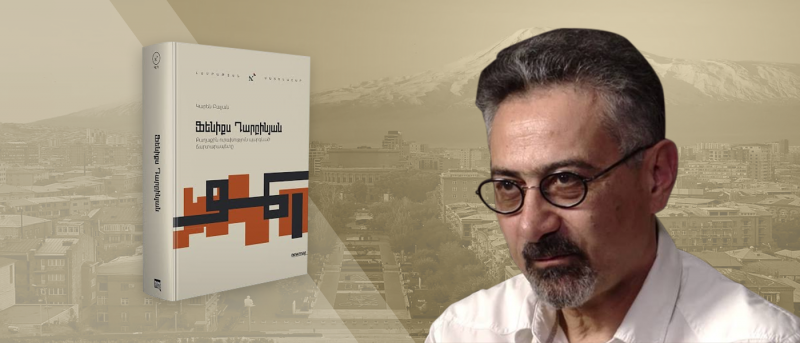
Professor Karen Balyan, the author of the book “Phoenix Darbinyan”, distinguished the three stages of the capital's architecture, and presented the architectural approaches of the given times and the reasons why they changed over the years. The theorist o
The face of Yerevan during the Stalin period
Three generations built this city: those who founded it in the 1920s, and 1930s and had a hard end. Some of the builders of the city ended up in the Gulag, and then came the architects of the Stalin period, who, however, changed the meaning of the city, the national city, which was being created as the first new Armenian capital, the capital of all Armenians, which was written in the city's master plan. It was replaced by the Stalinist totalitarian city, although the principles underlying the architecture of the national city were preserved. The direction of the entire city went to the north and directed towards Masis.
The statue of Stalin, building of the Central Committee were built, the center was moved, and the square was degraded, the perspectives to Ararat, to historical areas were closed. The principles of city development were preserved, the city continued to develop with 4-5-floor stone buildings, and most importantly, the principle of ensemble development of the city, which was set in the master plan of Tamanyan, was preserved. Even during the Stalin period, this was preserved, no matter how much they tried to eradicate the national idea.
The views toward Masis, the idea of free spaces, and the democratic ideas that were in the Tamanian plan, were canceled, but the historical forms were allowed, the building of the Supreme Council could be built with the composition of the church, the church portals could be placed in front of the entrance of the residential house, the entrances of the houses could be designed in this way, as is the 31 Moskovyan building.
There was also a generational change. The architects of the Stalin period had a fairly high professional training. They managed to maintain professionalism. Then came the short period of Khrushchev Thaw, when again some freedoms, apparent or real, entered Soviet culture. New architects began to create free architectural spaces and forms. Reinforced concrete became available, and until then almost nothing was built from it; the opera building, gradually some residential areas after the war, roofs, and bridges were built, and the market was constructed with the formwork of the Victory Bridge.
In the 1960s, new opportunities came, and buildings began to be built purely from reinforced concrete. The first structure was the exhibition pavilion. This modern structure was not similar to traditional architecture at all, but it turned out to be very consistent with both our ideas and the location, and it turned out that national architecture should not be only made of stone, national architecture should not have the obligatory historical old forms, but can be completely free.
The face of Yerevan in Hasratyan era
From there, the reconstruction of Yerevan began, which I call Project 2750. It already refers to the mayor Grigor Hasratyan, who was the mayor of Yerevan from 1962 to 1975. Abovyan Street, Sayat-Nova became a real part of that project. Yerevan was finally formed and got a capital image. The political building trends that existed in world architecture at that time were realized in Yerevan. In this sense, Yerevan of the 60s and 70s was completely in line with the entire European architecture. The structures created here were equal to the European ones in terms of their level, modernity, and architectural solutions.
The urban environment became the basis for Project 2750. The program was aimed at the jubilee of the city, which was celebrated for the first time in 1968. It was the maximum rise of the national spirit and mentality, and highly modern. This entire project was realized through a strong architectural group, an army of architects, among which there were both leading and not leading specialists, but all together formed a whole.
A little later the Demirchyan era began. Many large structures were implemented. The sports and concert complex was built, the subway, and the construction of the cascade began. All this ended on December 7, when the red line was crossed. Everything changed, architecture required resources, but everything was directed toward recovery, then, unfortunately, the war started, which coincided with the collapse of the Soviet Union.
The face of Yerevan in the post-Soviet period
A new generation came in the 90s, but they were unable to maintain the same level of activity as their teachers. We lacked talent and had an activity of architectural mediocrity. Added to this was the collapse of architectural institutes, when everything was centralized in large design institutes, the state order disappeared, and everything began to fragment. The city did not have a unified idea, it did not have any consistent order. The city did not have a client or a worthy and professional architectural executor. This is what I call a business project where profit continues to occupy all this space.
The main structures of the city, which were formulating its image, were demolished, the environment was destroyed, and the circular park, the main street of Abovyan, and the greenery, which together were forming one dimension, were separated. This was followed by more serious problems. perspectives were blocked by high-rise buildings, there was no general approach to the city, and buildings that were not related to the environment grew like mushrooms.
A new architectural generation has emerged today, although the Institute of Architecture and Construction does not generate much excitement, I see the rise of a new generation that will eventually be at the forefront of the city's development. Another thing is in what condition they will receive this heritage that was created during those three stages.
Share


Read also