
10 books that present the century-long plan of Turkey and Azerbaijan to intentionally genocide Armenians
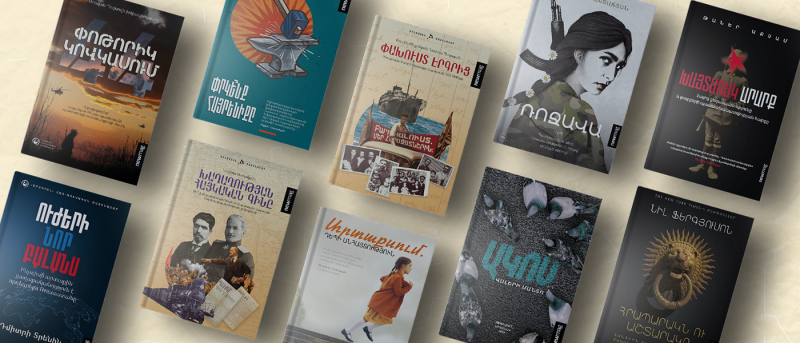
During the 5 years of its activity, Newmag has published books that show the genocidal policy of the Azerbaijani government. The publishing house's books are also documentaries about why the world shows a biased and insensitive attitude toward a nation th
Niall Ferguson's “The Square and the Tower” also addresses the German guilt in the Armenian Genocide in a shocking and completely new way within this biography of humanity. The Germans were trying to promote pan-Islamism, to start a religious revolt. Ferguson explains what the Germans were trying to do, why their plans failed, how the British defeated the Germans in the network battle, and how the Armenians became victims of this network confrontation of the European powers, losing most of their population and homeland.
The genocidal policies implemented by Turkey and Azerbaijan have been passed down by the generations of writer and lawyer Anna Astvatsaturian Turcotte. The writer's grandfather survived the Turkish massacre in 1915. 75 years later, her family was trying to escape from that tragedy again in Baku. The 8-year-old girl wrote what she heard and saw in a diary with her grandmother's advice. Years later, the story of a family became a book called “Nowhere, a Story of Exile” and was published in English, Russian, and Armenian. Now Anna is a well-known human rights activist in the United States, who also gives lectures and organizes awareness events about Azerbaijani atrocities.
Magda Tagtachian, another Newmag writer, reflects on the topic of the Armenian Genocide in all her books. Writing “Rojava”, published in Armenian, she had in mind her grandmothers who survived the genocide, who did not have any chance of armed struggle and were saved only by lucky chance. The search for justice, the fight for the truth, and the preservation of memory - these are the three preconditions for the literature she creates formulating a unique struggle for a dignified life and happiness.
Newmag translated into Armenian and published the book “Le Sillon” (“Agos”) about the Genocide of 1915. The author of the book is the French writer Valérie Manteau. The main character of the book is Hrant Dink, through whom the author shows that Turkey's past and present politics are the same. The book not only records the struggle of Dink but also of all the journalists who still want to voice the reality of what happened in Turkey and ended up in prison. The world on the edge of the abyss and the life of the murdered journalist is the theme of the book.
Turkish historian Taner Akçam was one of the first to give a cornerstone assessment of Turkey's criminality in the Armenian Genocide. After extensive research, the historian presents the work “A Shameful Act”, which is carefully researched and distinguished by the abundance of Ottoman and other sources. The book is also an accusation to the Turkish authorities.
In another book, “Killing Orders”, Akçam’s main goal was to study and present documents that no one had seen or studied before. According to the historian, Turkey mainly claims that there are no documents proving what happened in 1915, but the same exceptional sources and research show reality and these facts published in the book.
Years ago, European investigators revealed the mechanisms of bribing European bureaucrats in Baku and presented all these facts in a two-part report. The scandalous work reveals why Europe tolerates Aliyev's tyranny and crimes. Caviar diplomacy is based on a clear policy: to silence the alarms about human rights violations and spread historical and political lies about Artsakh in Europe. Aliyev created a scheme to bribe European officials years ago. First, he invited high-ranking foreign officials and employees of international organizations to his country at his own expense, and in the end, according to the protocol of caviar diplomacy, rewarded the guests in advance with expensive gifts. The “Caviar Diplomacy” report was translated into Armenian by Newmag.
In 1917, political forces were fighting and competing. Armenian intellectuals were caught between revolutions, wars, and treaties of empires. How did they perceive the historical realities, how were their ideas that came from the centers of empires and Europe and made decisions that drew the future Armenia on the map? “The Armenian Price of Peace” is about the fate of Western Armenia and the status of Eastern Armenia 100 years ago. Thanks to this book, the reader will find out what has changed in the ideas of Armenians about the right to self-determination after 100 years. Armenian thought was inspired by European values at that time. There was socialism, today is democracy. The main question remains the same: what kind of relations to build with Russia?
Following the publications of Tigran Hayrapetyan's “War and Politics” and “At the Edge of the Third World War”, Newmag presented the 3rd volume, “Shall we save the Homeland?”. Tigran Hayrapetyan's predictions written in 1990-1991 and published in this volume have been fully realized. Tigran wrote that the Armenian authorities are trying to establish relations with Turkey, to become partners, but they are not even able to ensure Turkey's neutrality in the matter of Artsakh. In 1993-1994, when we were liberating Artsakh, Hayrapetyan wrote: “The Nagorno-Karabakh problem is the touchstone that will show the limits of the Armenian people's ability to solve national problems... Artsakh is the last bastion of Armenia. If there is no Artsakh, there is no Armenia”.
A nostalgic novel about longing for the homeland, Ararat, the lost country, exile, and the fate of Armenians. The “Prix Goncourt” winner Andrei Makin's novel “My Armenian Friend” is a tender and sensitive story about the friendship between an orphanage student and an Armenian boy. Armenian families who came to Siberia, waiting for the trial of their relatives, lived in Devil’s Far Quarter. The charge was the creation of a secret organization ahead of the anniversary of the Genocide and the idea of restoring Armenia's independence. Political prisoners were held 5,000 kilometers from their homeland in an old monastery converted into a prison. Through the small Armenian kingdom and his Armenian friend, Vardan, the 13-year-old orphan boy discovers little Armenia and warm relations, which contrast with the harshness of Siberia and the cruelty of exile.
Share


Read also